
What is calm marketing? Grow your business without being online all the time.

I'm slowly writing and exploring the principles behind what I'm calling Calm Marketing – my own values-aligned approach to becoming discoverable online without burning yourself out or having to be online all the time. This post is an introduction to the framework. You can read more articles on this topic here.
Recently I went through an unexpected breakup of my long term relationship, at the same time as being diagnosed as Autistic. As you can imagine, this big life transition and discoverability led to me falling into a deep state of grief. So much so, that the idea of showing up online to market my business felt impossible for me.
While I lay in bed for three weeks with my ear plugs in and the blinds drawn to protect myself from any kind of sensory stimulation (hard out processing and trying to make sense of my new reality), enquiries and digital product sales continued to flow into my inbox. Even though I was doing no visible marketing at all, my business continued to be found and connect with the right people.
In a super challenging moment, this was such a huge relief for me. One less thing in a myriad of things I was worrying about.
This was all possible because I’ve created sustainable discoverability in my business.
In this article, I’m going to walk you through exactly how I’ve done this using my Calm Marketing methodology, so you can do it too.
Table of Contents
“Being found online” is not the goal
As small business owners, it’s impossible for us to be ‘on’ all the time. Life happens, our energy dips, big transitions come out of nowhere, we struggle with being visible or we simply just don’t want to be online all the time (because we know inherently that it’s not healthy for us). And yet, we do need to be continually found online.
It’s how we sell things, make money, continue to grow and keep doing the work that we love.
For the clients I support (ethical, heart-led brands), it's even bigger than that. They're doing important work in the world. Healing and supporting people and the planet, creating and advocating for change, and none of that can happen if the people who need them can't find them.
Being found matters.
So then why do many of us – capable, intelligent, passionate business owners – find marketing so damn exhausting, confusing or hard work?
Having had (many different iterations) of my online business for well over a decade now, I’ve asked myself this question a LOT. And I’ve spent much of that time having a love-hate relationship with marketing in general.
For me, where the resistance starts is that a lot of the marketing methods and tactics out there don’t appeal to me. Even more so, they actually make me feel gross. I don’t like when people market to me that way and I don’t want to market to others that way either.
And don’t even get me started on social media and how this feels all kinds of wrong to me (we could be here all day!).
Simply put, this kind of marketing just doesn’t align with my value system and ethics (and it’s definitely not supportive of my very sensitive, autistic brain and energy levels).
So there’s often this misalignment happening between visibility and values.
And what happens when there’s a misalignment with our values? Whatever we’re doing that’s out of alignment, eventually becomes unsustainable, we burn ourselves out. Ironically, in business, that makes the very thing we’ve been working towards – ongoing discoverability – unsustainable too.
So when we think about marketing like this, the goal “get found online” is a bit short sighted.
Instead, I reckon, the goal should be to get found online sustainably (aka sustainable discoverability).
This is what I call Calm Marketing.
So how do we do that?
Bear with me, I’ll get to the how shortly, but first for a bit more context (and so you can see this philosophy is grounded in actual real-world findings and experience) let’s go back a couple years to how this all came about.
How Calm Marketing came about: why do some have success with their marketing and others don’t?
Back in 2024, things got really quiet in my business (so much so that I started to wonder if it was time to chuck it all in and go back to traditional employment). Before I threw in the towel, I decided to have one last crack.
I started exploring how I could create sustainable discoverability so that I didn’t need to be online all the time, sell my soul to social media or continually worry about where the next enquiry was going to come from.
What I was looking for was a marketing approach that felt ethical, aligned, enjoyable and sustainable. It needed to be gentle on my nervous system and my client’s nervous systems and it needed to not take too much time away from the actual creative work I wanted to be doing.
I needed a marketing unicorn so to speak (wink!).
To cut a long story short, my research led me to Search Engine Optimisation (SEO). As I started to teach myself – and then eventually my clients – how to optimise their websites for search, I realised that this is actually only one part of a larger picture.
In truth, it’s relatively straightforward to set up your website to be found in search. But what I began to see with some of my clients is that just because you do the technical bits and pieces correctly, it doesn’t guarantee an improvement in your discoverability or, even if it does, that the people finding you will actually take the next step.
I began wondering: why did this optimisation stuff work super effectively for some businesses and not for others?
So I decided to reverse engineer it. I looked at the clients that had great results from this work and figured out exactly what they were doing differently from the clients that had less success.
And that’s how I discovered the three Calm Marketing pillars.
The three Calm Marketing Pillars that help you get found online
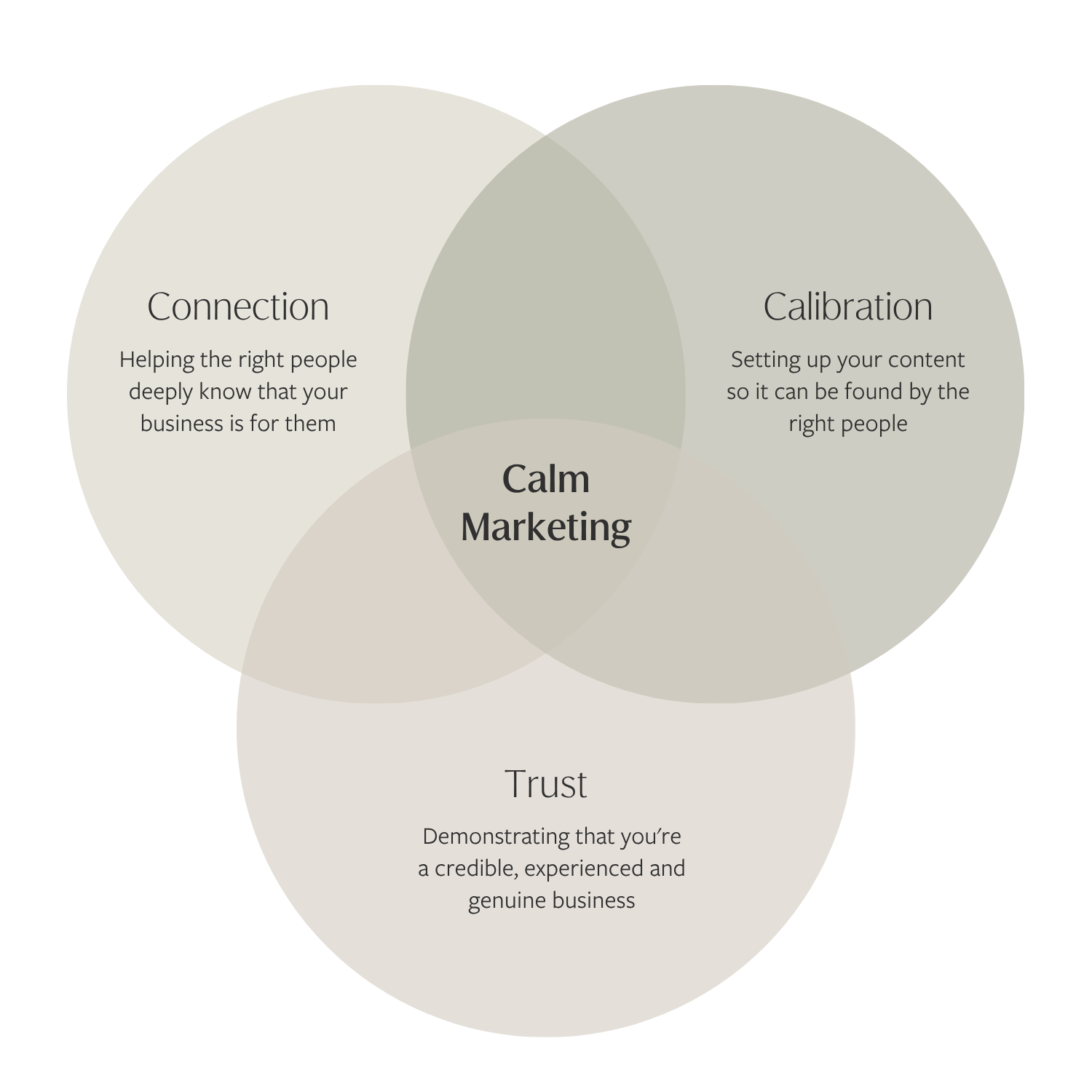
The three calm marketing pillars are:
Connection – helping the right people deeply know that your business is for them
Calibration – setting up your content so it can be found by the right people
Trust – demonstrating that you're a credible, experienced and genuine business
What I often see is that many small businesses do one or two of these pillars really well but are unknowingly lacking in the others.
This means that their marketing efforts often fall short. This can look like having a beautifully designed website but no one ever finds it. Or having people find your website but not engage with it or take the next step (like signing up or buying something from you).
However, the businesses that consider all three pillars, end up with a sustainable marketing system that brings them a steady flow of clients even when they’re not actively ‘marketing’ (just like in my case over the last three weeks).
Let’s take a look at each pillar in more detail.
Connection – helping the right people deeply know that your business is for them
While there’s no hierarchy to these three pillars (they’re all equally important), I’ve put the Connection pillar first because too often with marketing we are told to ignore our values, unique voice or messaging to ‘strategically’ meet some kind of marketing rules to be successful.
However, this is where traditional marketing advice falls short. You shouldn’t have to ignore your values or voice. In fact, your values, unique voice and messaging are the very things that are going to help you be found, connect with, stand out and be remembered by your audience (especially in the age of AI).
When reading something online, we’ve all had that moment one time or another of "ah ha, this person gets me". That’s the Connection pillar being done well.
To do this well, you need to know the deep why behind what you do, and the things that make your business different from others in your industry. It’s also about bringing in your values, experience, opinion and perspective. It’s being willing to say the things no one else is saying or even challenge common assumptions in your industry.
The Connection pillar is also knowing who it is you’re helping and then speaking directly to those people. This sounds simple, but it's one of the common places I see businesses get tripped up. The language you use to describe your work or how you solve a need / problem is not necessarily the language your clients would use to describe what they're looking for. When a gap like this exists, your clients may not ‘connect the dots’, failing to realise your work is for them or that it solves their problem, because you haven't voiced it in a way they recognise or resonate with.
Let’s take a look at an example from my own business:
My kind design philosophy was developed in 2019, while I was recovering from – what I refer to as – The Big Burnout (TBB). At that time – and forever more – the internet became a noisy, painful place for my nervous system. So, quite organically (almost accidentally) I started designing and building kinder, calmer websites in response to my own sensory needs.
Pretty soon, the feedback came flowing in – my clients (and my client’s clients) were reporting how calming and gentle my designs were on their nervous systems. And that's when my messaging “design that's gentle on your nervous system, good for people and considerate of the planet" began to take form.
It’s come from a why that’s deeply important to me, my value system and ethics (and through client feedback, of course). It challenges the status quo design and marketing advice that’s out there and it speaks directly to the kind of clients I want to work with. All these things combined help to create a message that resonates and is remembered by my ideal audience.
Where I see businesses struggle with the Connection pillar:
Businesses who don’t do the deeper thinking work (i.e what’s your values, deep why, key messaging, voice, unique perspective, ideal audience) before they start writing any content, tend to struggle most with this pillar.
And now with the rise of AI (where anyone can now write anything in 30 seconds flat), I see this pillar – which used to be done so well by so many businesses – suffering even more. By all means, use AI to help you do your research, structure your ideas and draft sections you find tedious (I totally do this).
But if you haven’t done the deeper thinking work, you’ll be very tempted to use AI to regurgitate your entire website copy (please don’t do this!), next sales page or blog post. Which means you’ll lose your unique voice and become indistinguishable from every other business in your space
Without the deeper thinking, that "ah ha, this person gets me" moment never happens for your audience, making it unlikely to inspire them to take the next step.
How to know if your Connection pillar needs work:
You’ve used AI to write most of the copy on your website
You’re unclear about your deep why or you haven’t communicated that across your website
You’re unclear about who you help and how and what makes you different from others in your industry
People are finding your website but they are not taking any action when they get there
Things you can do to improve your Connection Pillar:
Stop relying on AI to write your content
Start a blog – this is a great, low pressure way to find your writing voice, explore your unique point of view, highlight your values and experiment with ideas to find what connects most with your audience (check out this article on how to write blog articles that get found).
Work with a business coach or a copywriter – these professionals can help you define your values, deep why, key messaging, offerings and who you help (we have an inhouse copywriter so reach out if you need support in this space)
Calibration – setting up your content so it can be found by the right people
There are many different ways that you can get found online – social media, emails, paid ads, search etc. But let’s go back to the goal we set at the start of this article. The goal is to not just get found online. The goal is to create a mechanism for being sustainably found.
When I say sustainably, I mean in a way that doesn't require you to be a content creation machine, to be online all the time or to be showing up everywhere at once. It needs to work even when you’re not actively working it.
Let’s do a quick audit to see which online marketing methods meet our requirements and goal:
Social media requires you to constantly feed the beast. Bombarding your audience with loads of emails doesn't feel very kind. Paid ads aren’t very kind to the bank balance. Plus there's something deeply uncomfortable about handing money to platforms whose ethics we'd rather not support.
Search, however, is the one I want to pause on. Because this is the only free marketing method that is truly self-sustaining. When you calibrate your content so it is easily searchable, the people who are searching for what you offer, naturally and organically find their way to you.
It's not pushy or performative. It doesn't rely on manipulation, manufactured urgency or being a content creation machine. It just quietly works in the background, even when you’re not online (like when you take three weeks off to lie in a dark, silent room, like I did).
That’s why, for this pillar we’ll be focusing on calibrating your content to be found in search.
To do this, first work out what words and phrases your clients are typing into search when they’re looking for your support. Once you know the words and phrases your clients are using, you then make sure those words appear in the right places in your content. Search tools look for signals in specific spots to work out what each page is about. These include your page title, meta description, headings, images and the body copy itself. If you’d like help with this, check out The Calm Marketing Collection.
Once you’ve calibrated your content to be searchable, then search tools can more easily match your pages and posts to the right people.
Where I see businesses struggle with the Calibration pillar:
Most businesses struggle to get started with this not because it's hard, but because the SEO world has done a spectacular job of making it seem impossibly complicated with technical jargon and conflicting advice. No wonder most people give up before they begin.
But here's what I've found: it really does come down to a pretty simple formula. Work out the words and phrases your ideal clients are actually typing into search when they're looking for what you offer. Then make sure those words appear in the right places on your website. That's the core of it.
How to know if your Calibration pillar needs work:
You’ve created a website or written blog articles but nobody is finding or reading them
You're getting some traffic but the people landing on your website don't seem to be the right fit
You have no idea whether search even knows your website exists
Things you can do to improve your Calibration Pillar:
Check to see if people are finding your website through search (watch this helpful beginner-friendly tutorial on how to check your site rankings in Google)
Pick up a copy of The Calm Marketing Collection – it walks you through exactly how to find the right words your clients are searching for and where to put them on your website
Book a SEO audit with me.
Trust – demonstrating that you're a credible, experienced and genuine business
The trust pillar is about demonstrating depth and expertise in your chosen subject area.
One of the most powerful ways you can do this is through blogging. But to be clear – this isn’t just about blogging for the sake of it. It’s about deliberately choosing to go deep on the topics you want to be known as the expert in.
For example, I want to be known as an expert in Calm Marketing, hence why I’ve started the ‘calm marketing’ series on my blog and gone deep in this very article.
When you’re writing an article in which you want to demonstrate depth and expertise, include things like your experience with the problem, how you work to solve it, client case studies, your unique perspective and point of view and how this is different from what others in your same industry might do. This is very much about quality over quantity.
Additionally, and just as importantly, your entire website needs testimonials, qualifications and certifications, and backlinks (this is when another business mentions and links to your website) to build trust.
When you consistently demonstrate depth and experience two things happen. Firstly, your audience starts to trust that you genuinely know what you're talking about. It’s what helps to move someone from “this business looks interesting” to “I trust this business and I’m ready to take the next step.”
Secondly, search tools and AI start to recognise your website as a credible place to learn more about your chosen topics – and therefore they start recommending and surfacing your content more.
In many ways, your audience and search tools are asking the very same question: can I trust this business? You need to strongly send signals so they can see that your business is real, credible and experienced.
It’s also worth keeping in mind that for those working in health, wellness or mental health you need to pay even more attention to this pillar. Content that could influence someone's health is held to a much higher standard. Which means if you're a naturopath, therapist, coach, nutritionist, acupuncturist etc, demonstrating that you’re experienced and trustworthy matters more than it might for other industries.
Where I see businesses struggle with the Trust pillar:
Most businesses just simply don't demonstrate their expertise enough. They’ve done the work, have the experience and qualifications, they know their subject really well. But none of that is visible on their website. The good news is that with just a few little tweaks, you can immediately start to improve your trust pillar.
How to know if your Trust pillar needs work:
Your website makes claims about your experience or expertise but doesn't show any evidence of it
You have no (or very few) testimonials on your website
You've been blogging but your posts are short, surface-level or cover too many different topics without going deep on any of them
You’ve had someone do “SEO work” on your website but your site still isn’t ranking in Google or being recommended by AI
Things you can do to improve your Trust Pillar:
Start a blog – pick one or two topics you want to be known as the expert in and go deep on them. Aim to post at least 1-2 blog articles a month.
Gather testimonials – and then sprinkle them throughout your website
Update your About page – make sure it clearly explains your qualifications, experience, background and story behind why you do what you do. Add badges for professional qualifications and certifications.
Set up a Google Business Profile and start collecting reviews
Build backlinks by getting listed in directories and guest posting
Building sustainable discoverability takes time. But that's kind of the point.
What you’re building is a long-term foundation that will keep working for you while you get on with the work you actually love. One that doesn't ask you to perform, compromise your values or be online all the time to make it work.
Your people are out there. And with the right foundations in place, they will find you. You don't have to chase them. You don't have to sacrifice your ethics or your integrity to reach them. You just have to show up honestly and set things up so they can find their way to you.
That's what Calm Marketing is all about.
If you’d like help with building sustainable discoverability…
If you’d like help with creating sustainable discoverability using the Calm Marketing Methodology, I have various packages available depending on your needs and stage of business.
