

I'm slowly writing and exploring the principles behind what I'm calling Calm Marketing – my own values-aligned approach to becoming discoverable online without burning yourself out or having to be online all the time. This post is part of that. Read more about the Calm Marketing Methodology.
If you're looking for alternatives to social media marketing, you're not alone and you're not wrong to question whether there's a better way. Here's what I discovered about how to market without social media.
Back in 2024, my business felt like a rollercoaster. Some months, I’d have no enquiries at all, and other times, I’d be overwhelmed with requests. There was no consistency, no predictability, just worrying periods of no enquiries followed by intense bursts of busyness.
This kind of inconsistency started to feel unsustainable. While I was still financially managing, it made it impossible to build solid structures and grow my business. I couldn’t plan ahead, and I couldn’t confidently outsource or hire because I never knew if the work would keep coming.
I started to feel super frustrated and, at times, question everything: Does this business model even work? Am I going to have to find something else?
It wasn’t a great headspace to be in.
Then I hit one of the quietest periods I’d ever experienced in my business.
Table of Contents
Being a content creation machine
If you’ve been running a business for any length of time, you’ve probably asked the question – is it possible to do marketing without social media?
You’ve likely felt the pressure of constantly creating content – social media posts, email newsletters, blogs, and more. It’s never-ending, and the demand to keep producing fresh content can be exhausting.
Social media might give you a quick burst of visibility, but it’s often fleeting. A post can go viral one day and fade away the next, buried under the weight of the next trend or algorithm change. And with those algorithms constantly shifting, it feels impossible to keep up.
Blogging, too, can start to feel like just another task on an endless to-do list. Without a clear strategy, it often brings minimal return, leaving you pouring in effort but not seeing much payoff.
It’s easy to get discouraged when you’re working hard, but the results don’t reflect your efforts. Content creation can feel like a time sink with no real rewards, and eventually, you start questioning whether all this effort is even worth it.
With all this rattling around in my head, I found myself at a crossroads.
But, instead of hustling, marketing, and promoting on social media – where I’d always felt like I was shouting into a void – I decided to try something different.
Exploring alternatives to social media marketing
Social media had never been a strong source of enquiries for me. It demanded so much time and energy, but the return on investment just wasn’t there.
And if I’m honest, I never liked the way it made me feel. Constantly pushing and performing – at the mercy of an algorithm – goes deeply against my ethical small business philosophy.
I was definitely looking for a non-social media marketing approach.
So instead, I turned to search engine optimisation (SEO).
In simple terms, this meant making my website easy to find for the people already searching for the kind of work I do. Rather than chasing potential clients, I created a system that allowed them to find me – at their own pace, in their own time, when they were truly ready.
And that shift changed everything:
Enquiries flow in consistently and effortlessly – without me needing to post on socials or do any active marketing beyond refining and optimising my website.
I’ve had my highest and most consistent income months ever, and my biggest earning financial year to date.
I’ve hired two website designers to support me.
Instead of spending my energy on marketing, I get to focus on what I truly love—designing, working with clients, and creating websites that make a real impact.
And the best part? I’m fully enjoying my business again because I no longer have to worry about where the next enquiry is coming from.
See the actual results

This graph shows the number of times my site appeared in search results (purple line) and the number of clicks I received (blue line) over the last 12 months.
The results speak for themselves:
Consistent growth – from near-zero visibility to thousands of impressions each month.
Steady increase in clicks – more people are not only finding me but actively choosing to visit my website (and submit an enquiry form!).
Sustainable, long-term momentum – unlike social media, which requires constant posting, my SEO efforts continue to build upon themselves.
Instead of fighting against the algorithm, I optimised my site so that the right people could find me – at the right time, in the right way.
Non social media marketing that’s kind, calm and gentle on the nervous system
One of the things I love most about this shift is how much more aligned it feels with my overall business philosophy. It’s calmer, steadier, and far more sustainable – not just for my workload, but for my nervous system too.
Unlike social media, SEO doesn’t require me to perform for an algorithm or churn out content just to stay visible.
When you approach content creation with search in mind, your website becomes a long-term asset that continues to bring in people who are actively searching for what you offer.
And then you can focus on doing what you really love.
If you’ve ever felt drained by social media or uncertain about how to create consistency in your business, I get it. And if you're wondering whether there’s another way? There absolutely is.
Results from our clients who are using alternative marketing strategies to social media

“My counselling business was pretty slow and I had lost momentum, but since having Alana’s SEO support I am not only seeing a bounce back in client enquiries but it is higher than it has ever been.
I hadn’t ever really made the connection between client enquiries and my blog posts, but with Alana’s support, my posts have an increase in traffic which means I can speak to people who are specifically in my target audience.
The tips and strategies that Alana gave me for posting my blogs have changed the way that I approach the whole process and have made me realise that that way I was doing it was basically a waste of my time.
Now I feel excited about blogging and more empowered in creating traffic and interest which inspires me to create more in my business. The value in this is priceless.
With my new-found awareness of SEO and the potential of it for my business, I am feeling less chained to the grind of Social Media which honestly, has not been working for me for a long time. I now see where I get the best investment for my time and energy and can create content feeling confident that it is actually going to have an ongoing benefit to my business.”
- Nicole Mathieson, relationship counsellor
How to market without social media: here’s where to start
If you’re tired of constantly creating content for unethical platforms that feel out of your control and would love a more predictable, sustainable way to get found online, here’s how to start bringing more traffic to your website without relying on social media.
1: Find out if your website is visible in organic search
Before you do anything else, it's worth understanding where you're actually starting from. Are people finding your website through search at all? Which pages are being shown? What are they typing in to get there?
Google Search Console gives you all of this for free. It's one of the most useful tools available to small business owners.
If you haven't set it up yet, or you're not sure how to read the data, I've written a step-by-step guide to checking your website's search performance that walks you through exactly what to look for.
Once you know what the data is telling you, you'll have a much clearer picture of what actually needs attention.
2: Work out what your ideal clients are typing into search to find you
Honestly, this is where it all needs to start. If you don't know the answer to this question, getting your website to be found in search is going to be a struggle.
This is not something you want to guess. Because often the language you use to describe your work, can be very different from what your clients use.
It's really about finding your clients' language and then putting this language onto the pages on your website. When your pages use the same words and phrases your clients are searching, search tools are far more likely to match your content with your client’s search query.
So how do you work out what words and phrases your clients are using? Instead of guessing, there’s a pretty simple method to gather real data to work this out. If you need help with this, The Calm Marketing Collection steps you through exactly how to do this – with a helpful video and workbook.
3: Update your pages with your clients' language
Once you know the words and phrases your clients are typing into search, the next step is making sure those words appear in the right places on your website. Search tools look for signals in specific spots to work out what each page is about.
These include your page title, meta description, headings, images and the body copy itself. Getting these right means search tools can more easily match your pages to the right people.
If you'd like step-by-step instructions and videos to walk you through this, the Calm Marketing Collection covers it all.
4: Focus on blogging instead of social media posting
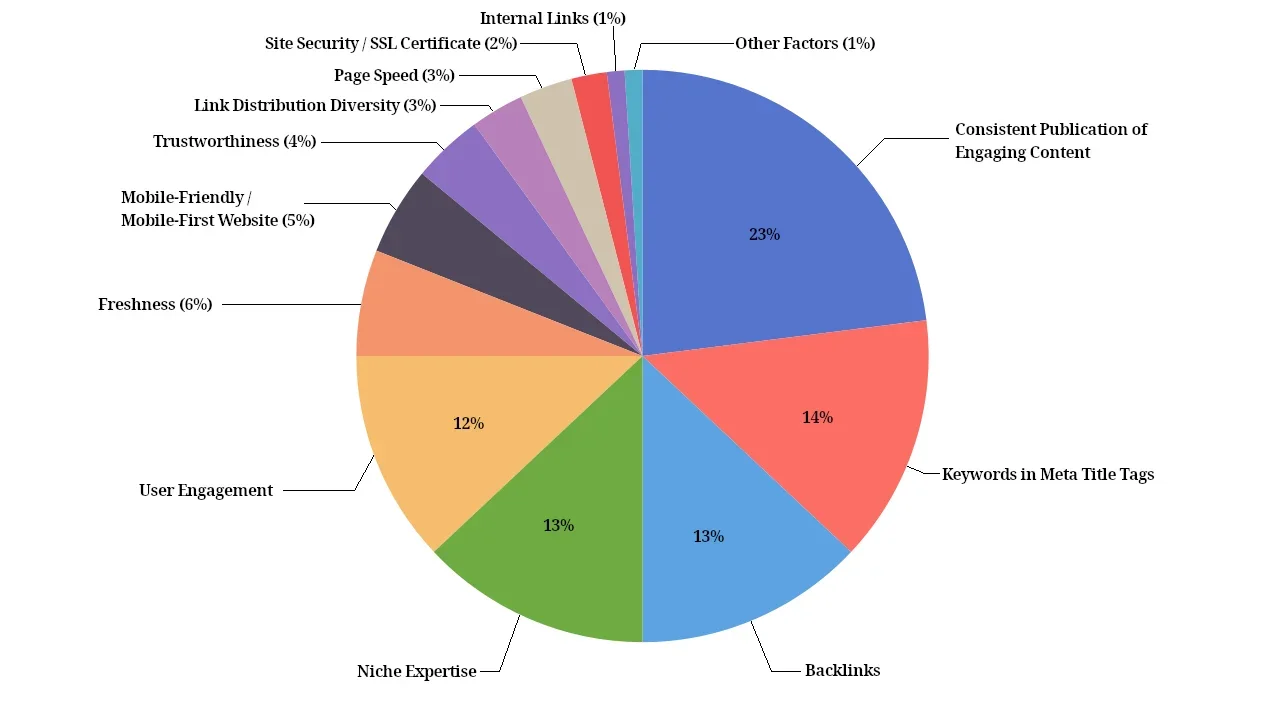
If you've ever wondered whether blogging is actually worth your time, this chart answers that question pretty clearly.
Source: FirstPageSage – Google Algorithm Ranking Factors
This is Google's ranking factors – the things Google looks at when deciding which websites to show in search results. The biggest single factor, at 23%, is consistent publication of engaging content. Niche expertise and freshness are also in the top five. All three of these are things you build directly through blogging.
Social media posting doesn't contribute to any of them.
Blogging is one of the most effective things you can do for your discoverability and earning trust with potential clients and it's worth understanding why, because it's quite different from posting on social media.
A social media post disappears within a day or two. A blog post, when written and structured correctly, keeps working for you quietly in the background, for months or even years.
But more than that, Google and AI tools are actively looking for signals that your website is a trustworthy, knowledgeable source in your area. Things like consistently publishing high quality content on your website that shows clear expertise in your field of experience. Blogging is how you do this.
Over time, a library of well-written articles on your core topics helps search engines and AI tools recognise your website as a reliable place to learn about your subject, that you know what you're talking about and therefore start showing your website to more people.
If you'd like to explore further how blogging compares to social media as a long-term approach, this article is worth a read.
One of the most relieving things I can tell you is that you don't need to be a content creation machine for this to work. As you can see from the chart above, what matters is consistency (unlike social media which relies on intensity).
I write one blog post a month. I make sure it’s structured correctly, then I share it with my mailing list, post it on social media, and then let it do its quiet work in the background. That's my content for the month done.
When I explain this to clients, I can literally see them exhale.
Each post builds on the last, deepening your authority with search tools and expanding your reach over time. Done right, a single well-written post can keep being found for months, even years after you publish it. That's something a social media post will never do.
If you'd like step-by-step guidance on how to write blog posts that actually get found by your ideal clients, the Blogging to Be Found guidebook inside the Calm Marketing Collection walks you through the whole process.
5: Create YouTube videos to support your blog articles
YouTube is a search engine in its own right. People use it to search for answers, recommendations and how-tos in exactly the same way they use Google.
Because Google owns YouTube, it regularly surfaces YouTube content on page 1 of Google search too. So, a well-optimised video can earn you a spot on page 1 of Google, separate from your blog article.
You then have two places you can be found by your audience – in YouTube or via your blog. Basically you’re expanding the potentials for people to find you.
In addition, you want to embed your YouTube video into your blog article. When someone lands on your blog article and stays to watch a video, they're spending significantly more time on your page than they would just reading. Google notices this – longer time on page signals that your content is genuinely useful, which can help it rank higher in search.
6: Make it easy for AI to find and recommend you
More and more, people are skipping Google altogether and asking AI tools for recommendations instead. AI looks at information from across the web to decide which businesses feel most relevant and trustworthy.
When your website is clear about what you do, who you help and where you're based, it becomes much easier for AI tools to recognise your work and confidently recommend you to the right people. The blog content, service pages and client stories you build up over time all contribute to this picture.
AI tools are still learning how to understand small businesses, which actually makes right now a good time to get your foundations in place. I've put together an AI Visibility Guidebook that walks through 10 simple changes you can make to your website to help AI recognise and recommend your business.
7: Build trust signals across your website
Search engines and AI tools aren't just looking for relevant content – they're looking for signs that your business is real, established and trustworthy to recommend. In many ways, they're asking the same question your potential clients are: can I trust this business?
Things like genuine testimonials, a clear About page that speaks to your experience and qualifications, portfolio work or case studies and listings in relevant directories all help to answer that question for both visitors and search tools.
A few simple places to start: add at least one testimonial to a main service page, make sure your About page reflects your expertise and check whether you're listed in any directories or professional networks relevant to your work.
Want to explore alternatives to social media marketing?
If you want to go deeper on all of this, the Calm Marketing Collection is a good place to start. It's a series of jargon-free guides, created specifically for ethical small business owners like wellness practitioners, creatives and non-profits, that walks through how to work out the words your client’s are typing into search, setting up your pages so Google understands them and writing blog content that actually gets found.
Frequently asked questions on marketing without social media
-
Yes, absolutely. Marketing without social media is not only possible – it can be calmer, more strategic, and more sustainable. Tools like SEO (search engine optimisation), email marketing, and strong website content help you attract people who are already searching for what you offer. You’re not shouting into the void – you’re showing up where people are already looking.
-
You absolutely can. Many small businesses (including us here at Alana Jade Studio) are quietly thriving without relying on social media. When your website is well-optimised for search engines and clearly speaks to your audience, you create a steady, reliable stream of enquiries. It's about building long-term discoverability – not chasing the next trend.
-
There are plenty of alternatives to social media marketing that don’t rely on algorithms or constant posting. Some of the most effective include SEO and website optimisation, email newsletters, blogging (with a content and SEO strategy), word-of-mouth and referrals, online directories or Google Business Profile. These methods often take less energy and build stronger foundations for long-term visibility.
-
Most people use Google (and more and more AI search platforms) to find what they need – whether it's a service, a local provider, or answers to specific questions. By using SEO, you can reach these people through your website and blog content. Instead of trying to “capture attention,” you’re making it easy for the right people to find you, when they’re ready.
-
You can, and many do (you’re looking at one right now!). Social media is one option – not the only one. If you focus on making your website work well (think: SEO, helpful content, and clear messaging), you can consistently attract clients without needing to show up daily on socials.
-
No, not necessarily. Social media can be useful, but it’s not essential. If it doesn’t feel aligned, or if it’s not producing results, it’s okay to step back. There are other ways – like SEO – that are more sustainable and often more effective for service-based businesses in the long run.
-
Without social media, you’re not automatically invisible. In fact, you can become more intentional with your marketing. It encourages you to focus on deeper, more strategic efforts – like SEO, building a great client experience, and sharing thoughtful content that works for your audience over time (not just for the algorithm).
-
100% yes. Success looks different for everyone, but it doesn’t have to be tied to constant posting. When you focus on building a solid, discoverable website and delivering real value through content, your business can grow in a way that feels good – and lasts – Alana Jade Studio is a great example of this.
-
If you've been relying on social media and it's starting to feel unsustainable or you just don't enjoy being online all the time, Search Engine Optimisation (SEO) is worth exploring as an alternative option to bring traffic to your website.
Rather than chasing an algorithm or showing up constantly to stay visible, SEO works quietly in the background. When your website is optimised for search, the right people can find you when they're actively looking for what you offer, without you needing to post, perform or be "on" all the time.
It takes a little longer to build momentum than social media, but once it's there, it's far more consistent and a lot gentler on your nervous system too.
