

If you're a web designer who's heard about the website in a week model and wondered whether it's actually possible to deliver something beautiful, professional and high-quality within a one-week timeframe – or maybe you've already tried offering one-week websites and it didn't quite go to plan – you’re in the right place.
I've built over 100 websites in a week and made it my signature offering. In this guide, I'll walk you through what the model actually is, how it's possible to deliver quality websites in such a focused timeframe and how to run the process in a way that is calm, manageable, professional and genuinely enjoyable (for both you and your clients).
Table of Contents
Key takeaways
A website in a week is a way of designing and delivering a professional website within a single, focused week, by working from an already-created base design rather than starting from scratch.
My signature approach is different from other designers – it's not about rushing against the clock or hustling. Instead, it relies on thorough communication and key preparation completed before build week even begins, so the week itself can be calm and enjoyable.
It suits designers who want predictable pricing, manageable scope and a process that's gentler on their nervous system, particularly those who are just starting out, highly sensitive, neurodivergent or recovering from burnout.
You don't need to abandon custom work to offer this. Many designers run both side by side, using one-week websites as a lower-priced, more accessible option.
Pricing is fixed rather than quoted per project, which removes the time-consuming custom quoting process and gives clients clarity upfront.
The model can also be easier to market than custom work, since clients can see exactly what they're getting before they invest.
What is a website in a week?
A website in a week is a way of designing and delivering a professional website within a single, focused week. It's sometimes also called a semi-custom website, a website sprint or a one-week website build.
Rather than starting from scratch for every project, the designer works from an already-created base design or template, which they then customise to suit each client's brand, content and goals. It's a more contained and repeatable approach than traditional custom web design.
Typically, one-week website projects are positioned as a ‘fast, hustle’ kind of web design model but that’s not how I see it at all. Instead, I know from personal experience that the website in a week model can be an effective way to create a web design business that’s more predictable and much gentler on your nervous system.
The structure makes projects easier to plan, price and repeat. When done well, it is supportive of your time and energy (and sanity!) and it means that your projects unfold predictably and to plan with far less of the scope creep, blurred boundaries and mental load that can come with custom work.
And for business owners, website builds can feel overwhelming but with the clear one-week timeline, the fixed investment and the ability to see what they’re getting before the project even begins, this makes the whole experience feel a lot calmer than a long, open-ended build. This is how you get a great outcome and create a positive customer experience.
Is it really possible to deliver a website in a week?
If you’re new to website design or you’ve primarily been offering custom websites, you might be wondering if it’s even possible to create a high-quality website, that your client actually loves in such a short timeframe, without stressing yourself out. Spoiler alert: it’s totally possible!
I reckon where website designers come unstuck with the one-week process is focusing purely on the build week and treating that as the most important part. But it’s actually not.
Delivering websites in a week in a way that's calm and enjoyable is really about everything that happens before the build week. It’s about having clear communication, documentation and systems in place for onboarding your client, collecting content and checking in with them so they feel taken care of (and are far less likely to fall into overwhelm and go MIA). It's about preparing everything so thoroughly that by the time build week arrives, there's nothing left to chase.
My build week process does not involve racing against the clock. As an autistic, highly sensitive website designer, my nervous system does not enjoy that or perform well under those circumstances.
Instead, I’ve setup the process in a way so that I enter the week feeling clear in my direction and have everything I need to do my job well. This allows me to sink fully into my creative zone and create something beautiful for my client – while my client feels calm and secure about what's happening and walks away with a website they're genuinely proud of.
There’s a few key steps to make this a reality which I walk you through further down in this guide so definitely keep reading for those tips. You can also grab a copy of my entire process – from very first enquiry through build through to handover – in the one-week website project plan and checklist.
Why I run my web design business this way
Back in 2019, I was recovering from severe burnout. I could only really work around five hours a day, and I'd never done website design before. So I decided to teach myself how to be a Squarespace website designer and start my own business around that.
As I delved more into it, I saw that custom website projects weren't going to work for me. The long, drawn-out projects that take weeks or months to complete seemed to be quite draining on my nervous system.
So I started to look for an alternative option and that's how I discovered the one-week website model.
At the time, most designers out there were positioning the one-week model as that fast, hustle kind of thing. That didn't really appeal to me either. So I went about developing my own system to create something that felt good for my wellbeing, for my burnout recovery and for the fact that I was just getting started in the design industry. I wanted a safe, calm container to work within.
From there, I went on to deliver 100+ one-week websites using this model. And now, I teach other designers how to do the same.
This is a good place to mention that I'm not here to say anything against custom projects. If you love custom design that’s awesome (and it’s totally needed for some types of clients)! What I am saying (in a very long winded way, ha!) is that we each need to find a way of working that suits us. One that is supportive and sustainable.
And if the traditional custom web model doesn’t suit your nervous system, your energy levels or just the way you like to work, the website in a week model is a really great alternative, or an excellent addition, if you want to offer both.
But for me, the one-week model has become the foundation of my signature guided website experience offering. It's allowed me to build something sustainable, predictable and genuinely enjoyable, on my own terms.
It made a significant difference to how I feel in my business – in my income, my client relationships and my day-to-day health, happiness and lifestyle. If you'd like to hear more about how and why I made the shift, I talked through it in depth in this podcast interview: create a calm business as a highly sensitive entrepreneur
How to know if this model is for you
You might be a great fit for the one-week website model if you're:
Just starting out, and looking for a safe, structured way to grow your business and build confidence
Highly sensitive, neurodivergent, or recovering from burnout, and need a process that's gentle on your nervous system
Tired of scope creep, blurred boundaries, and projects that drag on far too long
Spending hours on custom quotes with little return, and want to simplify your offers
Struggling to get the right information from clients, leading to delays, stress and frustration
Balancing design work with a day job, family or other commitments, and need a business model that fits into your life
Feeling disheartened from past projects that left you drained, underpaid or second-guessing your skills
It's probably not the right fit if you genuinely love the creative freedom of starting from a blank page each time, or your ideal clients consistently need highly bespoke functionality that a base design can't accommodate.
And just to be clear: this isn't an either/or decision. You don't need to abandon custom work to offer one-week websites. Plenty of designers run both side by side, using the one-week model as a lower-priced option for clients who don't need (or want to pay for) a fully custom build.
The benefits of offering one-week websites
Pricing becomes simpler. One of the gifts of this model is that the pricing is fixed, inclusions are clear and clients know exactly what they're investing in before they say yes. I can literally whip up a proposal in 10 minutes or less.
Projects become predictable. With a defined start date, build week and handover, I always know what's coming and when. That predictability makes it so much easier to plan income, manage my calendar and my energy.
Scope creep becomes manageable. Because the scope is defined upfront and the timeline is short, there's far less room for projects to go off the rails. I've found design boundaries are much easier to hold (and easier for clients to respect) when everyone knows the project has a clear end point.
It's gentler on your nervous system. For me, long, drawn-out custom projects carried a heavy mental load. Where as the contained, repeatable one-week process feels easier to sustain – especially if, like me, you're building your business around your health and lifestyle.
Clients love it too. With a focused week, a clear process and the ability to see what they're getting before they invest tends to create calm and trust. And when clients trust you, that makes projects a lot smoother with great results out the end!
It creates a middle price point in your offerings. One-week websites sit naturally alongside custom offerings as a more accessible option for clients who want a professional result but can't stretch to a full custom investment. Rather than losing those enquiries, you have somewhere to direct them.
How to calmly deliver a website in a week (the 9 key steps)
Prefer to watch rather than read? I cover this same process in this training video or keep scrolling for the full written breakdown.
Resources mentioned in the training:
Web design client onboarding process (the ultimate guide)
01. Work out if the client is a fit first
Not every client is the right fit for a website in a week so before anyone commits, you want to spend some time together to work out if the contained manner of a one-week website is going to be suitable for the client and their requirements. This is where the discovery call (or sales call) comes in.
(Of course, all of this assumes you've got the right enquiries landing in your inbox in the first place. If you're still working on that, here's my guide on how to get web design clients.)
The main thing you want to establish in the sales call is whether the client can work within the parameters of a one-week package. If the client has a very specific vision, wants a high level of customisation or has a long list of custom pages they need built, a website in a week is probably not right for them – and it’s best you both know that now than halfway through build week.
During this call, I’m also listening for whether they have what the process requires in terms of content. The three things I pay closest attention to are branding, photography and copy. I ask where they currently stand with each, and note any gaps – so I can shape a proposal that includes things like colour palette selection, stock photo curation or copywriting support if needed. If the gaps are too significant (and the client isn’t willing to invest in filling these gaps), then this is a signal to me that we aren’t the right fit and I let the client know this straight away.
02. Send out a proposal
If the client is a fit, I send a detailed proposal within 24 hours. The web design proposal covers everything we discussed on our call, along with a clear and transparent outline of what is included in a one week website package. This ensures we are both on the same page when we begin our collaboration together.
Website projects can tend to ‘blow out’ if a clear scope is not outlined from the beginning. The proposal helps to prevent this by outlining clear inclusions and deliverables, and setting boundaries around things like customisations and reviews.
Here’s an article where I explore how to keep your web design clients on schedule.
03. Onboard your client thoroughly
Onboarding matters in any website project – but in a one-week model, it's especially important. Because the timeline is short and contained, there's very little room to absorb delays. If your client is unclear on the process or unsure what's expected of them, the whole week can unravel quickly.
Getting onboarding right means your client is fully prepared before the project even begins – they know the key dates, understand their responsibilities and have had the chance to ask questions. This is the kind of clarity that allows a one-week website project to run calmly and to plan.
I've written a full guide to my web design client onboarding process if you'd like to explore this further.
04. Get high quality inputs from your client (on time)
My experience has shown me that when clients have high quality branding, photos and written words, it’s easier to create a beautiful site for them quickly, plus they get better results and see a much longer return on their website investment. In fact, these days this isn’t just an ideal in my business, it’s a non-negotiable.
Have you ever paid attention to how much longer it can take to design a beautiful site for someone whose branding is lacking, photographs fall short and copy is poorly written? It can be difficult to get a good result.
High quality assets make your projects more enjoyable and ease-filled (and they often leave you with a project you feel proud to add to your portfolio). They also result in the client having an online home they feel excited to share and offer you raving reviews about.
Equally important is getting that content on time. Late content is one of the most common reasons website projects get pushed – and unlike longer custom builds, when building a website in a week there's no buffer to absorb it. A missed content deadline can mean rescheduling the entire build week, which is disruptive for you, your client and any projects you have booked in after theirs.
All my clients receive a Website content gathering pack which include copy planners, checklists, questionnaires, resources and helpful tips giving my clients a structured format to follow to write their copy, have a successful photoshoot and get their branding assets in order. Not only is this supportive for the client, it eliminates the ‘back and forth’ that often happens when information and content are missing and when elements aren’t up to scratch.
I require all content to be delivered on the Friday before we kick off. This gives clients a natural buffer over the weekend if they've run close to the deadline, and it means I can review everything properly before I begin.
I also schedule a check-in call a few days before content is due. It acts as a reminder and gives clients a chance to ask any final questions as they're pulling everything together. It doesn't have to be long – but it makes a real difference to how supported the client feels and how smoothly things run.
I've written a full guide to collecting website content from clients if you'd like to go deeper on this step.
05. Do a home page mock-up before build week
Having your client sign off on a home page mock-up prior to the scheduled build week has the potential to save so much time. It’s much easier to change up colours, fonts and images in a mockup, as opposed to reworking them in a live site. Am I right?
With no time sucking surprises and your sole attention on building, home page mockups add a great amount of calm and predictability to your build weeks and they result in the client feeling confident and at ease.
This step also means that, come review day, there’s often very few change requests, because your client has been involved in the process along the way.
I use a dedicated home page feedback form to guide my client through the review process. It walks them through exactly what to look at – colours, fonts, overall visual direction – so their feedback is constructive, specific and stays within scope. It also gives them a clear understanding of what to look for, which helps relieve any overwhelm and makes it much easier for them to communicate what they want.
I also have templated email scripts that I send during the mockup phase – prompting the client to complete the feedback form in a way that keeps the project on track and ensures no boundaries are accidentally flexed.
06. Build from a base design or template
Creating a website in a week from scratch might be possible… but instead, I suggest using a base design, a pre-made template or pre-made section templates that you can piece together.
Base designs and templates make the process much quicker while still allowing for a huge amount of personalisation based on the client’s requirements, business and branding. Clients also love the idea of base designs because they can see what they’re going to get before they invest! This provides a great deal of safety during a time that can feel quite stressful for a business owner.
I’ve created my own base designs over time (tailoring them to the industries and clients I feel most passionate about working with!). Check them out over this way.
If you’re ready to create your own templated base designs, I highly recommend The Standout Squarespace Course (that’s an affiliate link btw!)– this is where you can learn the smart coding techniques I use in my one-week website base designs that make them easy and fast to duplicate (hello swift turnaround times!), and simple for my clients to maintain and edit after handover. Plus there’s a whole bonus course on template creation, too!
07. Structure your build week
Because you’ve done some prep in the week beforehand – you’ve got the home page mock-up signed off and you’ve got all the content from the client, the build week should typically go off without a hitch at this point. In fact, this is my favourite part of the process because I get to go into my creative world with no distractions and just focus purely on creating something beautiful for my client.
That said, having a clear plan for how each day of build week unfolds is what keeps things calm for your nervous system and on track. Without a plan, it's easy to lose time, lose focus or find yourself scrambling at the end of the week to get everything finished.
I like to work from a templated website checklist. I duplicate this list for each client and then I simply work through each task item, ticking things off as I go to ensure nothing gets missed and I’m not using up my mental capacity trying to remember every tiny step – nothing is left to memory or guesswork.
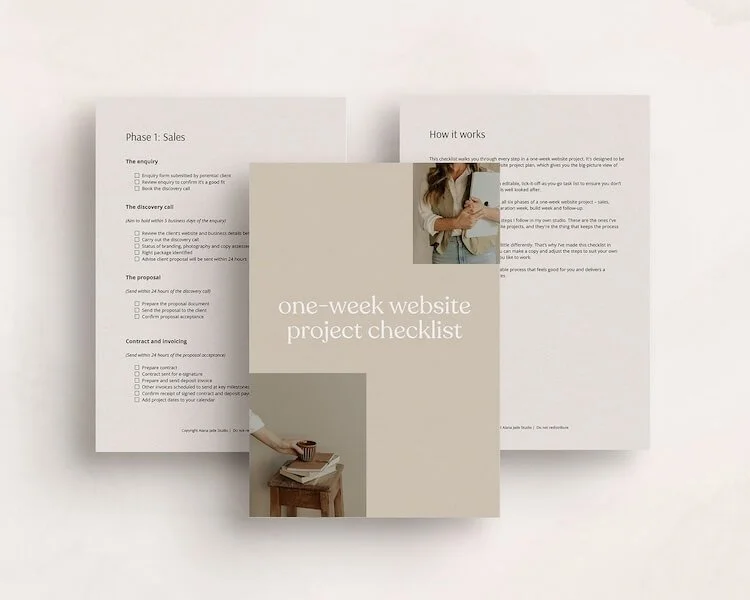
How I structure a one-week website project
If you’d like to see exactly how I calmly and ease-fully deliver websites in a week, the one-week website project plan and checklist walks you through the entire process, step by step and day by day.
08. Offer a review period, not review rounds
Review / edit rounds can easily blow out and be hard to put boundaries around – which is why I don’t offer them. Instead, we do a review period (that’s simply, a two-hour window on a set day) that involves both my client and I being online at the same time, and me making changes to the site as the client sends their requests through.
While two hours may not sound like a lot, I’ve found this is more than sufficient, because the client is already in love with and has approved the home page mockup.
Clients tell me they love having my undivided attention, and seeing changes happen in real time, during the review period. No waiting and back and forward – edits literally unfold before their eyes.
Setting clear boundaries and expectations for the review period is essential – and the right tools make this much easier. I use a website feedback form that guides the client through the site page by page, so their feedback is organised, specific and stays within scope. Rather than a stream of emails or a long list of unstructured requests, everything comes through in one place – which makes working through edits in real time much more manageable.
I also have a specific set of emails I send in preparation for and on review day. These set clear expectations with the client ahead of time, so they arrive to the review period knowing exactly how it works, what they can request and what falls outside the scope of the project.
09. Handover in a way that makes your client feel confident
One time-sucker many web designers face is past clients returning with loads of questions about their website. To alleviate this, I offer an in-depth web design handover pack complete with video recordings, to help my clients feel excited about and confident to manage their site independently.
I also provide one month of email support should they need me. However, because my handover process is so thorough and clear, I often find that my clients don’t need a lot of support – a win-win for both of us!
What tools and templates you need to get started
You don't need a huge tech stack to deliver websites in a week. The model doesn't really rely on fancy software or complicated systems. What’s more important is having the right documentation, communication and process in place. Here's what I use:
A base design or template.
This is the foundation the whole model is built on because rather than designing from scratch, you're customising an already-created design to suit each client.
I began with just one base design and used that single design for the first couple of years before adding more. There's no rush to have a big library of base designs or templates. In fact, one solid design can be much simpler because it’s way less ongoing maintenance as website platforms change over time.
In terms of creating your base design, you’ve got a few options here – create your own, learn the techniques for building them efficiently through a course like The Standout Squarespace Course (that’s an affiliate link btw!), or find a template seller online who licenses their templates for client project use.
Mockup software for the homepage design.
I use Adobe XD, though Figma works just as well. This is where the client signs off on the visual direction before build week begins, saving a huge amount of back-and-forth later.
Google Docs and Google Drive for sharing project files.
For collecting content from clients and sharing files, keep it really simple. Most clients already know how to use Google Docs and Drive, which means there's nothing holding them back from creating and sharing their content.
E-signature software for contracts.
I use Adobe Acrobat's e-sign feature, included with a Creative Cloud subscription. You could also use a CRM system like Dubsado or HoneyBook for this if you have one.
Client-facing communication tools and documents.
You're also going to need all the document templates that hold the whole process together – things like proposal, welcome guide, client questionnaires, handover materials.
Canva is a great option for creating these documents. It's free or low-cost, and lets you create polished, branded documents without needing design software like Photoshop or InDesign.
The actual wording, structure and content inside these documents is usually the harder part to figure out and get right. If you’d like to skip the hassle of creating these yourself, my website designer document toolkit has everything you need. It’s a complete set of editable document templates I use and rely on in my own studio for every project. You can just add your own branding and you're ready to go, using a proven process that you know works.
How to price a one-week website
One thing I used to dread when I offered custom websites, was quoting. And don’t get me started on the crickets I’d hear after pouring hours of time into them. One of the great gifts of the one-week website design process is that there is zero need to come up with custom pricing each time around because your pricing is fixed. This saves you a great deal of time and your client’s love it too because they know what the investment is up front.
The actual price point you put on your website in a week offering will be dependent on your experience, location and what's included but most designers price it as a middle tier, so somewhere between a DIY template and a full custom build.
If your client asks for customisations or you want to allow space for custom requests, an effective way to do this is by offering fixed price design days and fixed priced add ons – such as search engine optimisation, branding, e-commerce, scheduling or extra pages.
And, finally, if you're wondering whether you should even put your prices on your website at all, here's my ethical stance on pricing transparency.
How to market one-week websites
One of the things I love about the website in a week model is that you don’t need a big following, a large email list or a full portfolio before your offering really starts to sell. In my experience, I’ve found this model easier to market and sell than custom design work.
I reckon this comes down to these things:
Potential clients can actually see the design before they invest. They know exactly what they’re getting up front. And this kind of clarity helps create ease around what is quite a big investment for small business.
Your base design does a lot of selling for you. It’s proof that you can do what you say you can do and it acts like a portfolio piece.
It’s a lower price point than custom design, which makes the offering very competitive in the marketplace and appealing to smaller businesses.
You can target a specific audience. I encourage you to create a base design that’s focused on a particular industry that you really want to work with. When you do this, you’re then able to search optimise your sales page for that client type, making it much easier for your ideal clients to find you.
I share my full approach to attracting one-week website clients (without a big following or social media) in how to get web design clients.
Final thoughts
If you've read this far, you can probably tell I’m pretty passionate about the one-week model – it’s has genuinely changed how I experience running a web design business. And from everything my clients tell me, it's given them a calmer experience too.
That doesn't mean it's the only way to run a design business or even the right way for everyone. But if you've read this and felt a sense of relief or maybe recognition, that could be something worth paying attention to.
You don't need to overhaul your whole business. You could start with just one base design, try it with one client and see how it feels. If you do give it a try – let me know how you go!
Need help designing websites in a week?
The one-week website project plan gives you the exact process I follow – a complete project plan and editable client checklist for every stage, from first enquiry to launch.
Frequently asked questions about website designing in a week
-
Yes – many web designers offer websites delivered within a single week. It's made possible by working from an already-created base design or template, which is then customised to suit each client's brand and content. Clear inclusions, a defined timeline, high quality client content prepared in advance and a structured review process are what make it work. When these elements are in place, a professional, high-quality website can absolutely be designed and delivered in five business days.
-
Not at all. You can add it alongside your existing custom work as an additional offering – and many designers do exactly that. It works well as a middle price point for clients who want a professional result but can't stretch to a full custom investment. I used to offer both before eventually transitioning fully to the one-week model, but plenty of designers I know run both happily side by side.
-
This is one of the most common pressure points in any website project – and it's worth having a clear process in place to stop this from happening. A well-designed welcome guide and content pack sets the expectation early, and having email scripts ready for chasing content means you're not scrambling to find the right words mid-project. Building a content deadline into your project schedule – with a clear consequence for missing it – also helps protect your build week. If you’d like to learn more about my website content gathering process read this article: how to get website content from client
